
How to Train MMA Grappling for Better Control

A clean double leg means little if you arrive in guard with your head exposed. A tight armbar is not enough if you cannot hold position long enough to use it. To train MMA grappling well, you need to connect takedowns, control, submissions and safe striking awareness into one dependable skill set.
That is what makes MMA grappling different from treating wrestling, Brazilian Jiu-Jitsu and striking as separate subjects. It rewards the person who can make good decisions while tired, under pressure and in awkward positions. The goal is not to collect techniques. It is to become difficult to put down, difficult to hold down and dangerous when you earn a dominant position.
Train MMA Grappling for the Rules You Face
MMA grappling has its own priorities. In pure BJJ, playing from your back can be a strong attacking choice. In MMA, the same position may leave you absorbing strikes, working harder to control distance and relying on the referee to recognise your activity. Guard is still an essential survival and submission position, but it is rarely where you want to settle.
That does not mean BJJ is less valuable. Far from it. Brazilian Jiu-Jitsu gives you the positional understanding, escapes, submissions and calmness that make grappling effective. MMA asks you to adapt those skills. You must think about posture, head position, wrist control, wall pressure and the space needed for an opponent to strike or stand.
The same is true of wrestling. A takedown should not finish when your opponent hits the mat. You need to land in balance, avoid being trapped in a guillotine, pass their legs or pin their hips, then establish a position where they cannot simply scramble away. The best takedown is often the one you can control afterwards.
For self-defence-minded students, this approach has practical value too. A calm clinch, reliable balance and the ability to control someone without unnecessary escalation are more useful than complicated moves performed only under perfect conditions.
Start With Position Before Submission
Beginners often see grappling as a race towards chokes and joint locks. Experienced practitioners know that submissions become far more reliable when position comes first. If you can hold side control, mount or back control while keeping your own balance, opportunities appear. If you rush, you create space for your training partner to escape, reverse or strike.
Use a simple sequence in every round: secure the position, improve your control, then attack. From side control, for example, keep your weight connected through your chest and hips, block the near-side shoulder from turning in, and monitor the far hip so your partner cannot recover guard easily. Only once their movement is limited should you begin hunting for an arm, neck or transition to mount.
This is not passive grappling. Pressure is active. It requires small adjustments, good posture and awareness of the opponent's frames. In MMA, it also means maintaining a position that lets you stay safe while creating controlled space for strikes when the rules allow.
The most useful positions to develop
Your training should repeatedly return to a small number of high-value positions: the clinch, top half guard, side control, mount, back control and the ability to stand safely from bottom. You do not need to ignore leg locks, open guard or creative transitions. They all have a place. But these core positions give you the strongest base for competition, MMA cross-training and practical control.
Train both sides of each position. If you are strong from mount but panic underneath it, your game has a gap. Spend time escaping, recovering guard, turning to your knees safely and standing up with structure. Confidence comes from knowing you have answers when the round is not going your way.
Build Takedowns That Lead Somewhere
A good MMA takedown begins before the shot. It begins with distance, stance and hand fighting. If you reach with your head down or step too square, a competent partner can sprawl, frame, strike or circle away before the exchange starts.
Develop a small set of entries that suit your body type and experience. A body lock from the clinch, a single-leg from a controlled tie, and a double-leg when the opponent's posture is broken are enough to create a useful starting system. Drill the setup, not only the finish. Learn to move your feet, create an angle and keep your head positioned safely.
Then train the follow-up. Your first attempt will not always work. When a single-leg stalls, can you run the pipe, switch to a body lock or return to the clinch without giving up your back? When your opponent sprawls, can you keep connection, build back to your feet and try again? MMA grappling is often won in these second and third efforts.
Against the wall, patience matters. The cage can help you pin an opponent, but it can also trap your own posture. Keep your hips close, use your head position intelligently and avoid bending at the waist. Work to pull their hips away from the wall before expecting an easy finish.
Learn to Grapple With Striking Awareness
You do not need to turn every BJJ class into a hard MMA sparring session. In fact, doing so too early often makes beginners tense and careless. Instead, add striking awareness in a controlled way.
When you are on top, ask whether your posture would leave you vulnerable to upkicks, elbows or frames. When you are underneath, ask whether you are controlling the opponent's posture, covering intelligently and creating a path back to guard, a sweep or the wall. Light positional drills can teach these lessons without turning training into a brawl.
For example, begin in closed guard with the top player focused on safe posture and the bottom player focused on breaking posture and controlling wrists. From side control, let the top player practise stable pressure while the bottom player builds frames, protects their head and works an escape. The intensity can rise as your technical control improves.
The trade-off is clear: adding strikes changes the pace and emotional pressure of a round, so technical detail can suffer if you go too hard too soon. Build the mechanics in BJJ and wrestling training first. Then test how they hold up with realistic constraints.
Use Rounds With a Clear Purpose
Hard sparring has value, but only when it serves a specific goal. Rolling every round at maximum intensity may improve toughness, yet it can hide technical weaknesses and make consistent training harder. Purposeful rounds create faster learning.
Start with positional sparring. Begin from bottom side control, a front headlock, back control or a wall clinch, then give each person a clear objective. One athlete escapes or stands; the other holds position, submits or returns them to the mat. Short rounds create many repetitions without spending ten minutes waiting for the same position to appear naturally.
After that, use open rounds to connect the pieces. Aim to notice where your plan breaks down. Perhaps you can finish a takedown but lose top position. Perhaps your guard retention is solid, but you hesitate when it is time to stand. Those observations tell you exactly what to work on next.
Keep a simple training note after class. Record one position that felt strong, one recurring problem and one detail to test next session. This small habit turns training from exercise into deliberate progression.
Condition for Repeatable Effort
MMA grappling demands more than strength. You need grip endurance, hip mobility, trunk control, aerobic fitness and the ability to recover between explosive efforts. The answer is not to exhaust yourself every day. A body that is constantly battered struggles to learn and is more likely to get injured.
Build your conditioning around your mat work. Technical classes and live rounds provide sport-specific effort. Add sensible strength work for pulling, pushing, squatting, hinging and carrying, with attention to good movement rather than ego lifting. Easy cardio can improve recovery without draining your energy for training. As competition approaches, more intense intervals may be useful, but they should support your skill sessions rather than replace them.
Sleep, food and recovery are part of the programme. If you are returning after time away, work shifts or family commitments, consistency beats dramatic bursts of effort. Two focused sessions each week, sustained over months, will change your grappling far more than one punishing week followed by three weeks off.
Train With Partners Who Help You Improve
The quality of the room matters. You need training partners who challenge you, but who also understand control, safety and mutual progress. Tap early when a submission is locked in. Release immediately when your partner taps. Communicate clearly about injuries, intensity and experience.
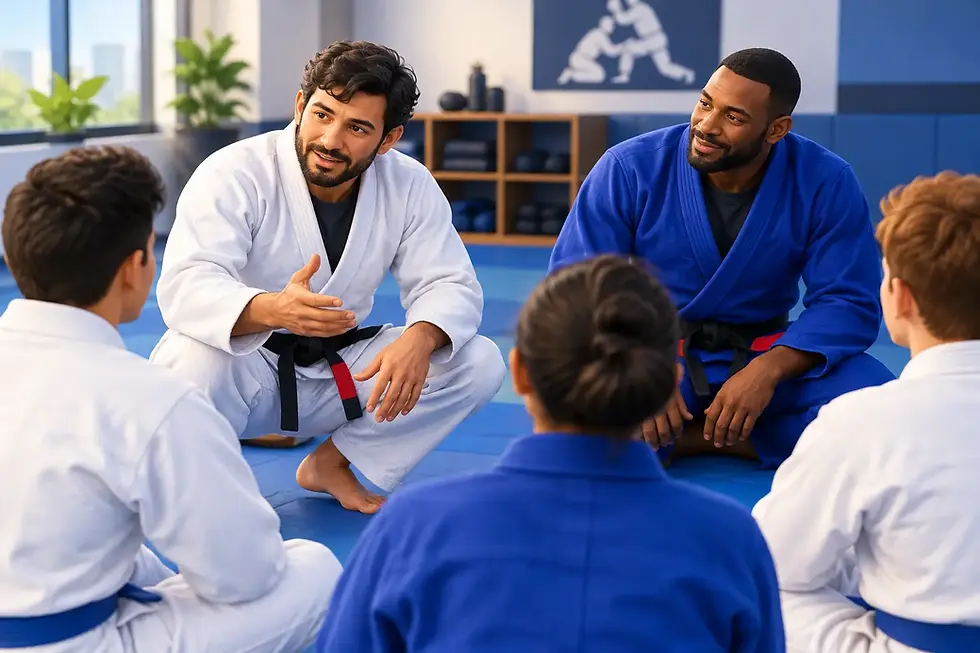
For complete beginners, a structured academy removes much of the uncertainty. You learn how to fall, frame, move and train safely before pressure increases. More experienced students benefit from the same structure because technical coaching keeps bad habits from becoming permanent. At Attitude BJJ Academy, students can build that foundation through BJJ while developing the grappling awareness needed for MMA and competition.
Your progress will not be measured by winning every round. It will show up when you stay composed beneath pressure, recover from poor positions and make better choices one exchange at a time. Step on the mat ready to learn, give your training partners the same respect you expect, and let consistent work build the confidence that carries beyond the gym.


Comments