Best Grappling Classes for Fitness Near You

A hard session should leave you feeling challenged, not lost. The best grappling classes for fitness give you more than a tough workout: they teach you how to move with purpose, solve problems under pressure and build conditioning that carries into daily life.
For many people, the gym becomes repetitive. You can lift, run or attend a class without needing to think much beyond the next set. Grappling is different. Every round asks you to use strength, balance, timing and composure against a resisting training partner. You are working hard, but you are also learning a skill. That combination is why Brazilian Jiu-Jitsu can be a powerful and sustainable route to fitness.
What makes grappling effective for fitness?
Grappling trains the whole body in ways that are difficult to reproduce with isolated exercises. You pull, push, frame, grip, bridge, rotate, squat, crawl and control your own bodyweight. Your heart rate rises quickly during drills and live rounds, while the technical nature of the sport gives your mind a job to do as well.
A typical class can develop muscular endurance, mobility, coordination and cardiovascular fitness without making every session feel like a circuit. The intensity changes naturally. One moment you may be carefully drilling an escape; the next, you may be working through a demanding round from a difficult position.
There is a trade-off. Grappling is not a shortcut to fitness, and it can feel unfamiliar at first. Beginners often discover that good technique matters more than trying to overpower a partner. That is a positive lesson. With the right coaching, you learn to manage effort, breathe under pressure and become more efficient rather than simply going harder.
Best grappling classes for fitness: the signs to look for
The right academy should make fitness progress feel structured, safe and achievable. A packed timetable or impressive-looking room is not enough on its own. Pay attention to how the class is taught, how new people are welcomed and whether the training culture supports long-term consistency.
Coaching that teaches, not just exhausts
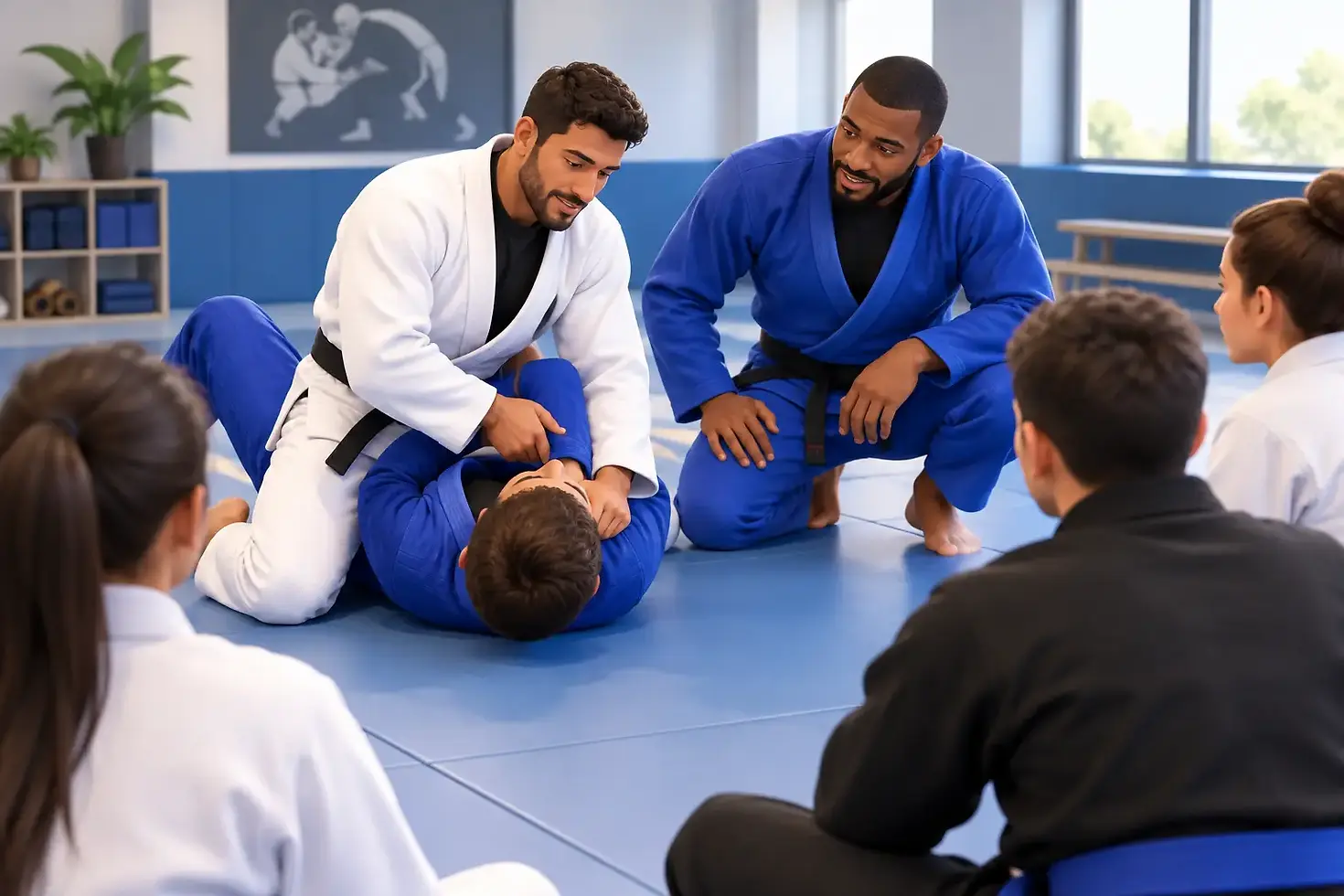
A good class has a clear purpose. Your instructor should explain the technique, show why it works and give you time to practise it before increasing the pressure. You should know what you are trying to achieve in a drill, whether that is improving your posture in guard, escaping side control or learning to control distance.
This matters for fitness because sound technique lets you train regularly. If every class is simply a battle of strength and fatigue, beginners can become discouraged or pick up avoidable aches and injuries. Experienced coaching helps you work hard while developing control.
Look for instructors who can adapt the same movement for different people. A competitive athlete, a parent returning to exercise and an older teen starting martial arts may share the mat, but they will not have identical needs. The best coaches maintain standards while giving useful options for different bodies and experience levels.
A beginner pathway with real progression
You do not need to arrive fit, flexible or confident to start Brazilian Jiu-Jitsu. You do need a place that understands what a first session feels like. Beginners should be shown the basics of safe falling, tapping, positional control and training etiquette before being expected to handle more demanding sparring.
A strong programme builds from simple positions and movements towards more complex sequences. You learn how to defend yourself, recover a better position and apply submissions responsibly. As your understanding grows, your fitness improves alongside it because you can spend more time moving productively and less time panicking.
Ask whether the academy offers a genuine introduction to the sport rather than dropping new students into an advanced class. A one-week free trial can be particularly useful: it gives you enough time to experience the coaching style, meet the team and see whether the timetable works with your life.
Training partners who make improvement possible
Fitness is easier to maintain when you want to return. That often comes down to the people on the mats. A supportive grappling community does not mean easy training. It means partners train with control, respect taps immediately and understand that everyone is there to improve.
You should expect intensity at times, particularly as your confidence grows. But intensity must be matched with good judgement. A training partner who is much larger or more experienced should be able to help you learn, not make every round a survival test.
The right room also gives you accountability. When people know your name and notice your progress, it is easier to show up after a long day. Over months, that consistency matters far more than one heroic workout.
A balance of drilling, positional work and live rounds
For pure fitness, it may be tempting to judge a class by how exhausted you are at the end. Sweat is not a complete measure of quality. The most effective sessions combine technical drilling with controlled resistance and, where appropriate, live sparring.
Drilling builds patterns and confidence. Positional rounds let you practise a specific challenge repeatedly, such as escaping mount or passing guard. Live rounds test your decisions against an opponent who is trying to stop you. Together, they create a demanding workout with a clear learning outcome.
If your aim is general fitness, you do not need to spar at maximum pace in every round. You can build intensity gradually. Technical rounds with a calm, experienced partner can be physically demanding while still allowing you to learn and protect your body.
Choosing between gi, no-gi and self-defence classes
Brazilian Jiu-Jitsu is not one single training experience. The format you choose affects the pace, grips and skills you develop, although all can contribute strongly to your fitness.
Gi Jiu-Jitsu uses a traditional jacket and trousers. The grips slow some exchanges down and create detailed technical problems around control, balance and escapes. Many beginners appreciate the extra connection because it can make positions easier to understand, though gripping can be demanding on the hands and forearms.
No-gi training is practised in athletic clothing without the jacket grips. It is often faster, with greater emphasis on body positioning, wrestling-style control and movement. It can suit people interested in MMA or those who prefer a more direct pace. Neither format is automatically better for fitness. The best option is the one you enjoy enough to attend consistently.
Self-defence-focused sessions add another useful dimension. They help you understand awareness, distance management and practical responses to common situations. If confidence and personal safety are part of your reason for training, this can make your fitness work feel even more purposeful.
How often should you train for results?
Two classes per week is an excellent starting point for most beginners. It is frequent enough to build familiarity and conditioning, while giving your body time to adapt. After several weeks, some students add a third session, strength training or easy cardio depending on their goals and recovery.
Trying to do too much too soon is one of the quickest ways to lose momentum. Your neck, fingers, shoulders and hips may need time to adjust to grappling's unusual demands. Prioritise sleep, drink water, eat enough to support training and let small niggles settle before they become bigger issues.
Progress will not look the same every week. Some sessions, you will feel sharper and fitter. Others will reveal gaps in your technique. Both are part of the process. The goal is not to win every round; it is to become more capable, composed and consistent over time.
Find a class that gives your effort direction
When visiting an academy, notice whether the coach is attentive, whether partners train responsibly and whether you leave with a clearer understanding of what you practised. Those details are more valuable than promises of a quick transformation.
At Attitude BJJ Academy in Christchurch, training is built around technical instruction, disciplined progress and a community that welcomes people at every stage. Whether you want to improve your conditioning, develop genuine self-defence skills or pursue competition, the mat gives you a place to test yourself and keep moving forwards.
Your first class does not need to prove anything. Arrive ready to learn, train at a sensible pace and give yourself the time to grow into the challenge. The fitness will follow, along with the confidence that comes from knowing you earned it.


Comments