
Jiu-Jitsu Versus Krav Maga for Real Confidence
- luiz marcellino
- 6 days ago
- 5 min read

A confrontation rarely starts with a clean punch from five metres away. It may begin with someone grabbing your clothing, crowding your space, or forcing you off balance at close range. That reality shapes the jiu-jitsu versus Krav Maga question. Both systems can build confidence and self-defence awareness, but they solve problems in very different ways.
Choosing well is not about declaring one martial art superior. It is about being honest about your goals, the quality of coaching available, and the kind of training you will commit to consistently. The best style is the one that gives you useful skills, keeps you engaged, and develops calm decision-making under pressure.
Jiu-Jitsu Versus Krav Maga: The Core Difference
Brazilian Jiu-Jitsu is a grappling art built around control, positioning, escapes and submissions. It teaches you how to manage an opponent at close range, especially when the situation goes to the ground. Rather than relying on strength alone, you learn leverage, timing, balance and body mechanics to create control.
Krav Maga is a self-defence system designed around immediate responses to threats. It commonly includes striking, defensive movement, releases from grabs, awareness drills and escape. Its central aim is simple: create an opportunity to get away from danger as quickly as possible.
That distinction matters. BJJ usually asks, “How do I control this person safely and effectively?” Krav Maga more often asks, “How do I disrupt the threat and leave?” Neither question is wrong. They apply to different moments and different priorities.
What Brazilian Jiu-Jitsu Builds
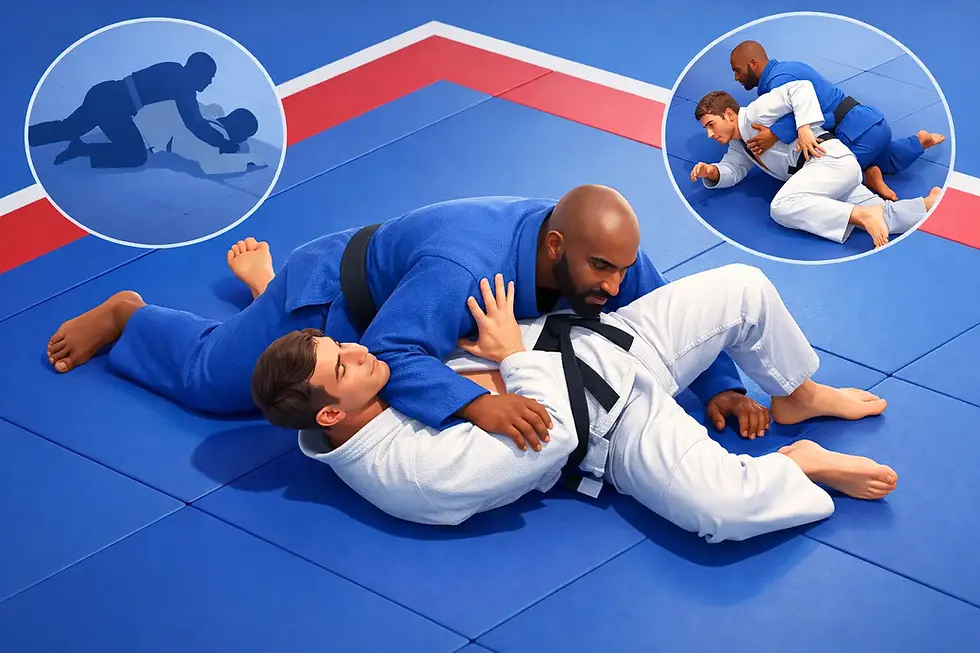
BJJ gives students a detailed understanding of what happens once distance disappears. You learn how to maintain a stable base, protect yourself from common positions, escape pins, regain guard, control limbs and stand back up safely. These are valuable skills when a person grabs, tackles or tries to hold you down.
A major strength of Jiu-Jitsu is live resistance. In controlled sparring, often called rolling, your training partner is actively trying to improve position, escape your control or submit you. You cannot rely on a technique working because everyone politely agrees that it should work. You learn to adjust when your timing is late, when your balance breaks, or when your first idea fails.
This makes BJJ a powerful teacher of composure. Being pinned by a larger training partner can feel uncomfortable at first. With good coaching and steady practice, that discomfort becomes a problem to solve rather than a reason to panic. Students begin to breathe, frame, move deliberately and make better decisions.
BJJ also offers a clear long-term path. The technical depth is substantial, with gi and no-gi training each presenting different grips, speeds and tactical choices. Beginners can focus on survival and basic control, while experienced practitioners can refine transitions, submissions, takedowns and competition strategy for years.
There are limitations. Pure BJJ does not make striking a central focus, and sport habits must be adapted for self-defence. Pulling guard, remaining underneath an opponent, or staying engaged on the ground may be sensible in a match but risky on concrete or around other people. Good self-defence-focused BJJ coaching addresses this by prioritising positional awareness, standing up safely and creating opportunities to disengage.
What Krav Maga Builds
Krav Maga is attractive to people who want a direct self-defence framework. Classes may cover verbal boundaries, situational awareness, striking vulnerable targets, defending common grabs and moving towards an exit. For someone who has never trained before, this can feel immediately practical.
It also recognises a point every martial artist should understand: avoiding violence is usually the best outcome. Distance, awareness, de-escalation and escape matter. In a dangerous situation, there are no medals for proving technical superiority.
A well-run Krav Maga programme can introduce striking and self-protection concepts quickly. It may include scenarios that BJJ classes do not always emphasise, such as managing unknown objects, navigating confined spaces or recognising the risks posed by multiple attackers.
Its challenge is consistency of training quality. Krav Maga is not one universally standardised competition sport, so methods and instructor experience can vary greatly between schools. Some programmes train techniques against genuine resistance and use protective equipment for realistic drills. Others rely heavily on compliant repetitions, where a defence appears effective because the attacker reacts exactly as expected.
A technique does not need to look complicated to be useful, but it should be tested sensibly. Under adrenaline and fatigue, simple movements practised repeatedly tend to hold up better than a long sequence that only works at half speed.
Which Is Better for Self-Defence?
The honest answer is that it depends on the threat and the training environment.
If somebody clinches, tackles or pins you, BJJ provides highly relevant tools. It teaches you what pressure feels like and gives you methods for escaping inferior positions without needing to overpower the other person. For many adults, the ability to stay calm in close contact is one of the most valuable self-defence benefits available.
If your priority is striking, rapid disruption and leaving the area, Krav Maga may better match that immediate objective. It can offer a broader introductory view of personal safety, particularly when it is taught by experienced instructors who understand both violence prevention and pressure-based training.
However, no martial art gives a guaranteed answer to real violence. Hard surfaces, weapons, multiple attackers, alcohol, surprise and legal consequences all change the situation. Even an excellent grappler should avoid going to the ground if escape is possible. Even a capable striker should understand that punches are unpredictable and close-range clinches happen quickly.
For a rounded skill set, many people benefit from combining disciplines over time. BJJ develops control and pressure-tested grappling. Striking training develops range management and punching mechanics. Self-defence education adds awareness, boundaries and escape priorities. You do not have to learn everything on day one, but it helps to know what each area contributes.
Fitness, Confidence and Community
Your decision may also come down to what will keep you training next month and next year. BJJ is demanding, but it is highly scalable. New students can work with cooperative partners, build fitness gradually and increase resistance as their confidence grows. Every round offers a measurable challenge, whether you are learning to escape side control or improving a familiar sweep.
Krav Maga classes can be intense and energetic, particularly for those who enjoy pad work and scenario drills. The pace may suit someone seeking a practical fitness outlet with a strong self-protection focus. Ask how beginners are introduced, how instructors manage contact, and whether the class includes controlled resistance rather than only rehearsed movements.
Community matters in both. The right academy should be disciplined without being intimidating. You should be able to ask questions, make mistakes safely and train with partners who want you to improve. Confidence is not built through being thrown into the deep end without support. It is built through regular challenges, capable coaching and proof that you can handle more than you thought.
How to Choose Your First Class
Start by defining what you want most. If you are drawn to technical grappling, long-term progression, fitness and learning how to handle close physical contact, Brazilian Jiu-Jitsu is a strong choice. If you mainly want a broad introduction to personal safety, striking and escape-focused scenarios, explore a credible Krav Maga school.
Then watch how the class trains. Are instructors clear and attentive? Are beginners treated with patience? Do students practise with enough resistance to learn what works, while still keeping each other safe? A supportive culture is not soft. It is what allows people to train hard, return consistently and improve.
At Attitude BJJ Academy, beginners can experience that process through a one-week free trial, with structured coaching that supports self-defence goals as well as technical progression. You do not need prior fitness, experience or a competitive background to begin. You only need the willingness to learn.
The most useful first step is not arguing about styles online. Step onto the mat, feel the difference between theory and controlled practice, and choose the training that helps you become calmer, stronger and more capable when pressure arrives.


Comments