
No Gi Training Guide for Stronger Mat Skills
- luiz marcellino
- 11 minutes ago
- 6 min read

No-gi exposes every gap in your movement. Without a jacket to slow the exchange or give you a familiar grip, posture, balance and timing become impossible to ignore. This no gi training guide gives you a practical starting point: how to train with purpose, stay safe and build skills that hold up against a resisting partner.
For beginners, no-gi can feel fast at first. That is normal. The goal is not to match the pace of the most experienced person in the room. It is to learn how to remain composed, protect your position and make good decisions one movement at a time.
What makes no-gi training different?
Brazilian Jiu-Jitsu fundamentals remain the foundation in both gi and no-gi: control distance, establish position, escape bad situations and submit only when control is secure. The difference is in the tools available to you. In no-gi, you cannot rely on sleeve, collar or trouser grips. You use wrist control, head position, underhooks, overhooks, body locks and pressure instead.
This means grips are less permanent and scrambles happen more often. A position that feels secure in the gi may disappear quickly when an opponent can turn, pummel for an underhook or slip their arm free. Good no-gi training therefore rewards active connection. Keep your elbows close, use your head intelligently, and connect your hands to their wrists, arms, shoulders or torso rather than reaching from too far away.
No-gi also has a closer relationship with wrestling and MMA. You may spend more time learning takedown entries, standing defence, wall work and how to control posture without fabric grips. That does not make gi training less valuable. Training both develops a broader understanding of Jiu-Jitsu, but each format asks you to solve familiar problems differently.
Build your base before chasing submissions
The fastest way to improve is often less exciting than hunting for a flashy finish. Your first priority should be positional awareness. Learn the difference between being safe, being threatened and being in control.
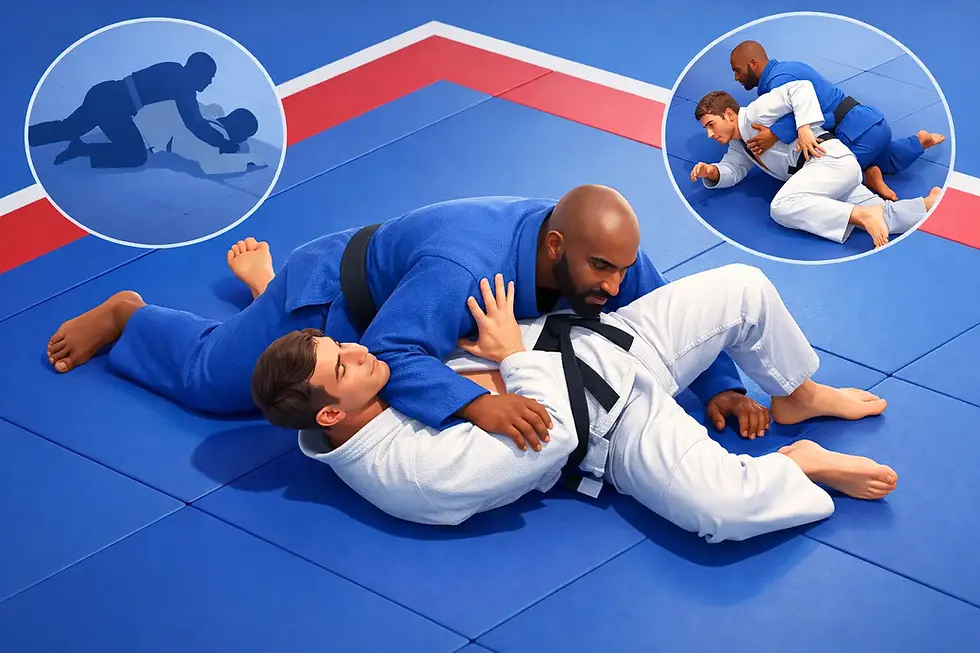
From bottom, focus on frames, hip movement and recovering guard. A frame is a structural barrier created with your forearm, hand, shin or knee that stops your partner from collapsing their weight directly onto you. Strong frames create the small amount of space you need to escape. Do not push with straight arms from underneath heavy pressure. Keep your elbows connected to your ribs where possible, use your skeleton rather than just muscular effort, and move your hips before trying to force a big action.
From top, learn to stabilise before advancing. If you pass the guard and immediately reach for a submission, you may give away the position you worked hard to earn. Settle your weight, remove their frames and anticipate the escape they are likely to use. Side control, mount and back control become far more effective when you understand how to make your partner carry your pressure without relying on strength.
A simple rule helps: position first, pressure second, submission third. You will still have opportunities to attack, but your attacks will be cleaner because your partner has fewer ways to move.
The no gi training guide to grips and connection
No-gi grips are not really grips in the traditional sense. Think of them as points of connection that help you steer your partner, disrupt their balance or prevent their next movement. The most useful early connections are wrist control, inside biceps control, collar ties, underhooks, overhooks and body locks.
A wrist grip can stop a post, reduce an opponent's ability to hand-fight or open an angle for a takedown. A collar tie, placed behind the head rather than around the neck, helps manage posture and distance. An underhook gives you access to their torso and can make it difficult for them to turn into you. But none of these positions is permanent. Your partner will fight to clear them, so avoid holding on rigidly.
Instead, link your controls together. If you lose a wrist, move to an inside tie. If your underhook is blocked, use head position and an overhook to stay connected. This is where drilling matters. Repetition teaches your body to recognise openings before you have time to overthink them.
Head position deserves particular attention. When you are standing or working from a top position, keep your head close to your opponent rather than leaving it floating at a distance. Used correctly, it supports posture, blocks their movement and makes your own control stronger. Used carelessly, especially when driving forward with poor alignment, it can put pressure on your neck. Ask your coach where your head should be in each position and practise it deliberately.
Train at the right pace in sparring
Rolling is where technique meets resistance, but hard sparring is not the only way to improve. Every round should have a purpose. Some rounds are for applying a new technique. Some are for survival from a difficult position. Some are for testing your conditioning or competition strategy. Treating every roll as a fight to win usually leads to rushed decisions, poor habits and unnecessary injuries.
Positional sparring is one of the best tools for developing no-gi confidence. Start from side control, mount, back control, closed guard, half guard or a leg-entanglement position, then work towards a clear objective. The person underneath may be trying to escape or recover guard, while the top player aims to hold position or advance. Because the problem is specific, you get more useful repetitions than you would from restarting a full round after every scramble.
Match the intensity to your experience and your partner. A newer student benefits most from controlled rounds with enough resistance to make technique honest. A more experienced competitor may need higher-paced exchanges, wrestling rounds and focused tactical work. Both approaches belong in a good academy. The key is knowing why you are training hard on a particular day.
Tap early and without embarrassment. A tap is not a failure. It is clear communication that protects your training partner and allows you to return to the mat tomorrow. This is especially important with chokes, joint locks and leg attacks, where trying to tough out the final stages can turn a learning moment into time away from training.
Condition for movement, not exhaustion
No-gi can be demanding because it often involves more standing exchanges and quick transitions. Better fitness helps, but you do not need to arrive in peak condition before beginning. Consistent mat time will improve your stamina, coordination and ability to stay calm under pressure.
Outside class, a balanced approach works best. Strength training can support injury resistance and control, particularly through the legs, hips, back and grip. Walking, cycling, rowing or running can improve your aerobic base. Mobility work can help you reach sound positions without forcing your joints. The right balance depends on your schedule, recovery and training goals. If you are attending several hard sessions each week, adding more maximal workouts may slow your progress rather than accelerate it.
Sleep, hydration and regular meals are part of your development too. You do not need a complicated diet to train well, but under-fuelling makes it harder to learn, recover and maintain a positive attitude when sessions become challenging.
Choose practical gear and look after your training partners
No-gi clothing should be close-fitting enough that it does not snag or get pulled over your head, while still allowing you to move freely. A rashguard and grappling shorts or leggings are common choices. Avoid pockets, zips, hard plastic and loose clothing that can catch fingers or create distractions.
Good hygiene is a non-negotiable part of the team environment. Arrive clean, keep your nails short, wash training gear after every session and cover any cuts properly. If you have a contagious skin condition or feel unwell, take the sensible option and stay off the mats until it is safe to return. Respect for training partners is shown in the small habits as much as it is in a hard round.
Make progress visible
New students often measure improvement by whether they submitted someone. That is only one small signal, and it can be misleading. Better measures include escaping side control with less panic, maintaining your posture during a takedown exchange, recognising an underhook sooner or recovering guard before an opponent settles their weight.
Keep a short note after class. Write down one position you struggled with, one detail your coach corrected and one goal for the next session. Over weeks, this turns training from a collection of intense workouts into a clear process of development. Progress in Jiu-Jitsu is rarely linear, but it becomes easier to trust when you can see the small gains adding up.
At Attitude BJJ Academy, no-gi training is a place to test yourself, build real skill and train alongside people committed to getting better. Start calmly, ask questions, and give yourself permission to be a beginner. The confidence you want is built through showing up, learning the details and returning to the mat with purpose.


Comments